Epstein 2.0 and Deep State 2.0: How Palantir Powers a New Era of Surveillance

Jeffrey Epstein’s shadowy network of influence, built on blackmail and elite connections, was more than a criminal enterprise. It was allegedly a tool for control, possibly tied to intelligence agencies. Today, the terms Epstein 2.0 and Deep State 2.0 describe a chilling evolution: a system of surveillance and power driven by technology that scales Epstein’s tactics to entire populations. At its core is Palantir Technologies, a data analytics giant accused of weaving a surveillance web that could tap everything from government databases to Internet of Things devices like your smart fridge. This article argues that Epstein 2.0 and Deep State 2.0 are one and the same: a modern machine rooted in Epstein’s model, now supercharged by Palantir’s AI. Backed by solid evidence, we’ll unravel this convergence and its stakes for privacy.
Epstein’s Legacy: The Blueprint for Control
Epstein, a financier and convicted sex offender, operated a web of influence from the 1990s until his death in 2019, ensnaring figures like Bill Clinton, Donald Trump, and Bill Gates. His tactics, which allegedly involved collecting compromising material, hinted at deeper agendas. A 2015 Haaretz report linked Epstein to Carbyne, a tech startup with Israeli intelligence ties, suggesting his investments served surveillance goals. Whitney Webb’s 2022 book, *One Nation Under Blackmail*, argues that Epstein’s network functioned as an operation backed by intelligence, rooted in the military industrial complex, to manipulate elites. Former U.S. Attorney Alexander Acosta reportedly said Epstein was shielded by higher government officials for providing unspecified information, fueling speculation of agency connections.
This model, using personal data as leverage, underpins Epstein 2.0: a systemic version where technology replaces physical blackmail. Deep State 2.0, a term coined after 2016, describes an unelected elite of tech moguls, spies, and bureaucrats wielding unchecked power. Together, they form a single concept: a surveillance state that globalizes Epstein’s control, with Palantir as its engine.
Palantir: The Tech Heart of Surveillance 2.0
Founded in 2003 with funding from In Q Tel, the CIA’s venture arm, Palantir was built to crunch massive datasets for intelligence. Edward Snowden’s leaks in 2013 exposed its Gotham platform as an NSA cornerstone, merging phone records, emails, and social media into actionable insights. By 2025, Palantir’s reach spans the globe: a $480 million Pentagon contract for the Combined Joint All Domain Command Control network, a NATO deal for the AI powered Maven Smart System, and a $30 million ICE contract for immigrant tracking. The UK’s National Health Service uses Palantir’s Foundry platform for patient data, while Ukraine and Israel leverage its AI for military operations.
Palantir’s capabilities mirror Epstein’s playbook on a vast scale. Where Epstein gathered secrets on individuals, Palantir aggregates data from diverse sources, including databases, financial records, and potentially Internet of Things devices, for its clients. A 2020 University of Cambridge study found that 90% of Internet of Things devices, like smart bulbs, lack strong security, leaving them open to exploitation. Palantir’s Kite plug in, which collects local data for central systems, raises fears that clients like the NSA could tap Internet of Things networks. No evidence proves Palantir hacks consumer devices, but its ties to agencies with a history of exploiting vulnerabilities, as shown by Snowden, make the risk plausible.
The Convergence: Epstein 2.0 as Deep State 2.0
Epstein 2.0 and Deep State 2.0 unite in their reliance on data as power. Epstein’s alleged blackmail targeted elites; Palantir’s tech enables mass surveillance, potentially monitoring entire societies. This fits the narrative of Deep State 2.0, which involves collusion between tech and intelligence. Peter Thiel’s ties to Trump and CEO Alex Karp’s support for Elon Musk’s Department of Government Efficiency amplify suspicions. A February 2025 Forbes report noted that Palantir’s stock surged 40% in 2025, driven by AI and government contracts, cementing its influence.
On X, users call Palantir the brain of a global technate, reflecting fears of a deep state driven by technology. A 2023 Privacy International report flagged Palantir’s NHS contract for risking patient data, citing its intelligence roots. Amnesty International’s 2020 report accused Palantir’s ICE work of enabling human rights violations, evoking Epstein’s unaccountable power. These concerns frame Epstein 2.0 as a systemic successor: data, not dossiers, now drives control.
The Internet of Things Backdoor Question
Claims that Palantir could access Internet of Things devices stem from its data prowess and the weaknesses of Internet of Things. A 2021 Stanford study on surveillance capitalism noted that firms like Palantir rely on legal data access, not always backdoors. Yet the NSA’s PRISM program, exposed by Snowden, showed agency access to tech data, raising questions about Palantir. A 2011 GCHQ report warned that Palantir’s tools risked excessive data collection. While no documents confirm Palantir targeting smart fridges, the technical possibility exists if clients exploit Internet of Things flaws.
The Other Side
Critics argue that Epstein 2.0 and Deep State 2.0 exaggerate Palantir’s role. The company claims it serves clients’ data needs, not hacks devices. Karp defends Palantir’s mission as vital for security. No solid evidence links Palantir to Epstein’s network or Internet of Things exploitation. A 2025 Consortium News piece cautioned against seeing a monolithic deep state, suggesting bureaucratic chaos explains much of the concern. Palantir’s secrecy, though, keeps distrust alive.
The Stake
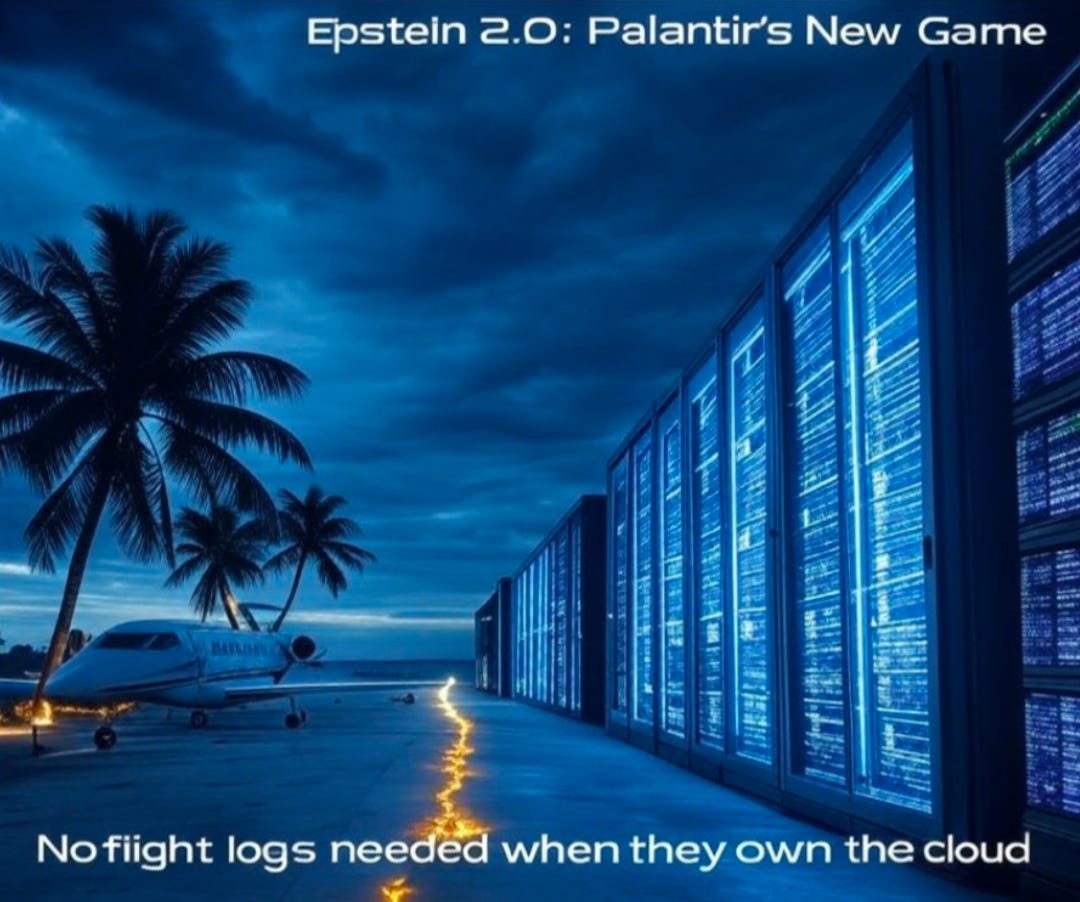
Epstein 2.0 and Deep State 2.0 describe a surveillance paradigm rooted in Epstein’s data driven control but scaled by Palantir’s tech. From CIA origins to global contracts, Palantir’s data integration mirrors Epstein’s manipulation, now targeting populations. Internet of Things backdoor fears, while unproven, are plausible given device vulnerabilities and Palantir’s clients. With a $3.74 billion revenue forecast for 2025, Palantir’s rise demands scrutiny. Epstein’s legacy, whether myth or not, warns of data as a weapon.
*What do you think? Is Palantir a guardian or a threat? Subscribe for more investigations and join the discussion in the comments.*
*Harry Humphrey Hard is an investigative journalist exposing power in the digital age. Follow him on X @InfoAssassin813